How Modern Connectivity Is Changing Work, Play, and Security
Discover how faster networks, connected devices, and digital security are reshaping everyday life.

Introduction
Modern connectivity has become a central part of everyday life. The internet is no longer limited to browsing websites or sending emails. Today, high-speed broadband, fiber networks, 5G, cloud platforms, smart devices, and connected services influence how people work, communicate, relax, learn, and protect their digital information.
The growth of connectivity is also changing what people expect from their networks. A connection needs to be fast, reliable, affordable, and secure enough to support several devices and activities at the same time. Recent OECD research shows strong growth in fiber, 5G, fixed wireless access, and connected devices, while the International Telecommunication Union describes meaningful connectivity in terms of quality, availability, affordability, devices, skills, and security.
The Rise of Always-On Connectivity
For many people, connectivity has become something they expect throughout the day. Smartphones, laptops, tablets, televisions, smart speakers, security systems, watches, and other connected devices can communicate through home and mobile networks.
The International Telecommunication Union estimated that approximately 6 billion people would be online in 2025. At the same time, access remains unequal, meaning that the benefits of modern connectivity are not distributed evenly around the world.
The technology behind connectivity is also changing quickly. Fiber provides high-capacity fixed connections, while 5G is expanding mobile capabilities with higher speeds and lower latency. Fixed wireless and satellite technologies can also help extend connectivity to locations where traditional infrastructure is difficult to deploy.
How Connectivity Is Changing the Way We Work
One of the biggest changes brought by modern connectivity is the ability to work from almost anywhere. Cloud-based applications, video meetings, collaboration platforms, digital storage, and messaging services allow employees and organizations to remain connected across different locations.
A person can participate in a meeting from home, access documents stored in the cloud, communicate with colleagues in another country, and continue working while traveling. This flexibility has changed expectations around traditional workplaces.
Reliable connectivity is particularly important for businesses that depend on real-time communication. A weak connection can interrupt meetings, slow cloud applications, delay file transfers, and make collaboration frustrating.
The OECD reports that demand for high-quality connectivity has grown alongside remote work, generative artificial intelligence, immersive technologies, and the Internet of Things. This means businesses increasingly need networks that can handle more data and more connected devices.
Better Connectivity Supports Flexible Work
Modern connectivity also supports hybrid working arrangements. Employees may divide their time between offices, homes, coworking spaces, and other locations.
This flexibility depends on more than download speed. Stability, latency, upload performance, network coverage, and security can all affect the working experience.
Businesses are therefore paying greater attention to network infrastructure, cloud access, device management, and cybersecurity. Instead of assuming that everyone works inside one physical office, organizations increasingly need systems designed for distributed teams.
How Connectivity Is Transforming Entertainment
Connectivity has also changed how people play and enjoy entertainment. Streaming video, online gaming, music platforms, social communication, and interactive applications all depend on reliable internet access.
Entertainment is becoming increasingly interactive. Instead of simply watching a television program at a scheduled time, users can stream content when they want it. Online games can connect players across different locations, while social platforms allow people to communicate instantly.
Higher bandwidth also makes it easier to use services that require substantial amounts of data. As networks improve, developers can create richer digital experiences involving video, gaming, virtual environments, and other interactive technologies.
Smart Homes and Connected Devices
The Internet of Things is another major part of modern connectivity. Smart lights, thermostats, cameras, appliances, watches, vehicles, and other devices can communicate with networks and sometimes with each other.
These devices can make everyday tasks more convenient. A connected thermostat may adjust settings automatically, while smart lighting can be controlled from a phone. Connected security equipment can provide alerts when unusual activity is detected.
However, adding more devices also creates a more complicated digital environment. Each connected device should be considered part of the overall security picture.
Connectivity and Digital Security
The benefits of connectivity come with important security responsibilities. More connected devices and cloud services can create more opportunities for unauthorized access if they are poorly protected.
Modern cybersecurity is therefore moving beyond the idea of protecting only a single office network. The National Institute of Standards and Technology explains that cloud computing, mobile devices, remote workers, and Internet of Things technologies have expanded traditional network boundaries.
One approach receiving significant attention is zero trust. Instead of automatically trusting a user or device because it is connected to a particular network, zero-trust architectures continuously evaluate access requests and security conditions.
This approach can be particularly relevant to organizations with employees working remotely and accessing cloud-based resources from different locations.
Simple Steps for Safer Connectivity
Individuals and businesses can take practical steps to improve digital safety.
Strong and unique passwords can reduce the risk created by reused credentials. Multi-factor authentication can add another layer of protection to important accounts. Keeping operating systems, applications, routers, and connected devices updated can also help address known security weaknesses.
Home networks should be protected with strong administrative credentials and appropriate security settings. Businesses can go further by managing devices centrally, controlling access to sensitive information, monitoring unusual activity, and applying security policies consistently.
Security should not be treated as an afterthought. As connectivity becomes more deeply integrated into daily activities, protecting connected systems becomes increasingly important.
The Connectivity Divide Still Matters
Despite rapid technological progress, not everyone has the same quality of internet access. The ITU’s Global Connectivity Report highlights differences involving income, location, affordability, devices, skills, and security.
This digital divide affects education, employment, communication, access to services, and participation in the digital economy.
The challenge is therefore not simply connecting more people. Meaningful connectivity requires services that are sufficiently reliable, affordable, usable, and secure.
What the Future of Connectivity May Bring
The next stage of connectivity is likely to involve even greater interaction between people, machines, cloud services, and artificial intelligence.
The OECD reports that machine-to-machine connections in OECD economies increased substantially between 2019 and 2024, reflecting the growing role of connected devices in transportation, energy, logistics, and smart manufacturing.
As more systems become connected, networks will need to handle increasing volumes of information while maintaining reliability and security.
Future connectivity may therefore be judged less by whether a person can get online and more by what they can reliably accomplish once connected.
Conclusion
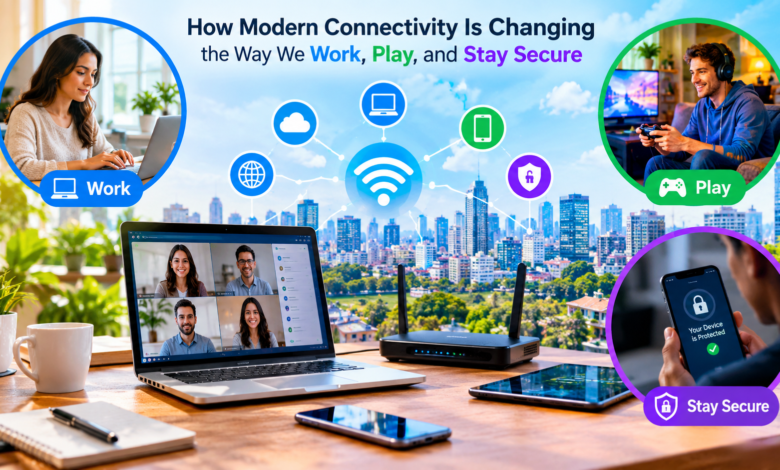
Modern connectivity is changing the way people work, play, communicate, and protect their digital lives. Fiber and 5G are improving network capabilities, cloud platforms are supporting flexible work, connected devices are transforming homes and businesses, and online entertainment is becoming increasingly interactive.
At the same time, greater connectivity brings new responsibilities. Security, privacy, affordability, digital skills, and reliable access must remain important considerations.
The connected future is not simply about faster internet. It is about creating dependable digital environments that help people and organizations communicate, create, work, relax, and stay secure in an increasingly connected world.